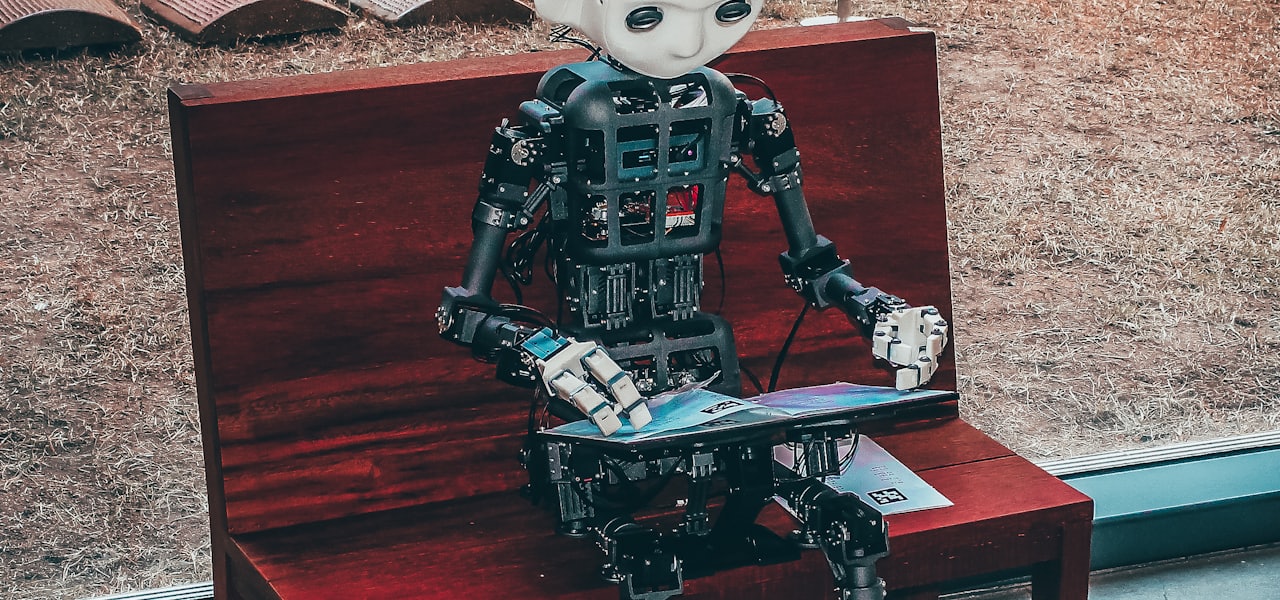
Computer operating systems (OSes) provide a set of functions needed and used by most application programs on a computer, and the links needed to control and synchronize computer hardware. On the first computers, with no operating system, every program needed the full hardware specification to run correctly and perform standard tasks, and its own drivers for peripheral devices like printers and punched paper card readers. The growing complexity of hardware and application programs eventually made operating systems a necessity for everyday use. == Background == Early computers lacked any form of operating system. Instead, the user (rarely also the computer operator), had sole use of the machine for a scheduled period of time. The user would deliver his program to a computer operator who would be responsible for loading the computer with the program and data needed for its 'run'. Eventually, the end of a user's program could be detected and a control program automatically loaded which would load the next user's program, relieving the operator of having to load in each user's program individually and introducing the era of 'batched' programming. That is, a number of user programs could all be loaded together in a batch. Loading of program and data was accomplished in various ways including toggle switches (only used by a user on the earliest of computers, but later used by the computer operator to control the computer, e.g., to start it up, to shut it down, to 'pause', to 'dump' its RAM contents, and/or to control its input and/or its output), punched paper cards and magnetic or paper tape. Once loaded, the machine would be set to execute each program singly until that program completed, crashed, exceeded its time limit or went into a(n infinite) loop. In those early days, there were only 'Control Program' units for providing the software necessary to control the computers and ancillary hardware, e.g., for such semi hardware functions as I/O . None of the early 'Control Programs' were sufficiently sophisticated to recognize a looping user program or initiate a recovery action. Detection and recovery from a looping program was another critical operator function and was usually detected by the sound of the looping computer, whereupon the operator would simply initiate a complete dump of the executing program (for later debugging by the programmer) and then load in (or instruct the computer to go on to) the next user's program. Programs could sometimes be debugged via a control panel using dials, toggle switches and panel lights, making it a very manual and error-prone process. But, this was quite rare, since the high cost of even the simplest of the early computers prohibited such exclusive use of a computer by an individual programmer. Almost all program debugging was done away from any computer by the original programmer perusing the program and the dump of its execution obtained, e.g., by the computer operator or automatically by some computer hardware exception detection (such as a timeout, an attempt to divide by zero, or an over or underflow). Programmers then could only very rarely have more than one computer 'run' per day! Symbolic languages, e.g., assemblers and compilers were developed for programmers to translate symbolic program code into machine code that previously would have been hand-encoded. Later machines came with libraries of support code on punched cards or magnetic tape, which would be linked to the user's program to assist in operations such as input and output. This was the genesis of the modern-day operating system; however, machines still ran a single program or job at a time. At Cambridge University in England the job queue was at one time a string from which tapes attached to corresponding job tickets were hung with stationery pegs. == Mainframes == The first operating system used for real work was GM-NAA I/O, produced in 1956 by General Motors' Research division for its IBM 704. Most other early operating systems for IBM mainframes were also produced by customers. Early operating systems were very diverse, with each vendor or customer producing one or more operating systems specific to their particular mainframe computer. Every operating system, even from the same vendor, could have radically different models of commands, operating procedures, and such facilities as debugging aids. Typically, each time the manufacturer brought out a new machine, there would be a new operating system, and most applications would have to be manually adjusted, recompiled, and retested. === Systems on IBM hardware === Building on customer experience and requirements, IBM took on a more active role in developing operating systems for the 709, 1410, 7010, 7040, 7044, 7090 and 7094. IBM also collaborated with universities. The state of affairs continued until the mid 1960s when IBM, already a leading hardware vendor, stopped work on existing systems and put all its effort into developing the System/360 series of machines, all of which used the same instruction and input/output architecture. IBM intended to develop a single operating system for the new hardware, the OS/360. The problems encountered in the development of the OS/360 are legendary, and are described by Fred Brooks in The Mythical Man-Month—a book that has become a classic of software engineering. Because of performance differences across the hardware range and delays with software development, a whole family of operating systems was introduced instead of a single OS/360. IBM wound up releasing a series of stop-gaps followed by two longer-lived operating systems: OS/360 for mid-range and large systems. This was available in three system generation options: PCP for early users and for those without the resources for multiprogramming. MFT for mid-range systems, replaced by MFT-II in OS/360 Release 15/16. This had one successor, OS/VS1, which was discontinued in the 1980s. MVT for large systems. This was similar in most ways to PCP and MFT (most programs could be ported among the three without being re-compiled), but has more sophisticated memory management and a time-sharing facility, TSO. MVT had several successors including the current z/OS. DOS/360 for small System/360 models had several successors including the current z/VSE. It was significantly different from OS/360. IBM maintained full compatibility with the past, so that programs developed in the sixties can still run under z/VSE (if developed for DOS/360) or z/OS (if developed for MFT or MVT) with no change. IBM also developed TSS/360, a time-sharing system for the System/360 Model 67. Overcompensating for their perceived importance of developing a timeshare system, they set hundreds of developers to work on the project. Early releases of TSS were slow and unreliable; by the time TSS had acceptable performance and reliability, IBM wanted its TSS users to migrate to OS/360 and OS/VS2; while IBM offered a TSS/370 PRPQ, they dropped it after 3 releases. Several operating systems for the IBM S/360 and S/370 architectures were developed by third parties, including the Michigan Terminal System (MTS) and MUSIC/SP. === Other mainframe operating systems === Control Data Corporation developed the SCOPE operating systems in the 1960s, for batch processing and later developed the MACE operating system for time sharing, which was the basis for the later Kronos. In cooperation with the University of Minnesota, the Kronos and later the NOS operating systems were developed during the 1970s, which supported simultaneous batch and time sharing use. Like many commercial time sharing systems, its interface was an extension of the DTSS time sharing system, one of the pioneering efforts in timesharing and programming languages. In the late 1970s, Control Data and the University of Illinois developed the PLATO system, which used plasma panel displays and long-distance time sharing networks. PLATO was remarkably innovative for its time; the shared memory model of PLATO's TUTOR programming language allowed applications such as real-time chat and multi-user graphical games. For the UNIVAC 1107, UNIVAC, the first commercial computer manufacturer, produced the EXEC I operating system, and Computer Sciences Corporation developed the EXEC II operating system and delivered it to UNIVAC. EXEC II was ported to the UNIVAC 1108. Later, UNIVAC developed the EXEC 8 operating system for the 1108; it was the basis for operating systems for later members of the family. Like all early mainframe systems, EXEC I and EXEC II were a batch-oriented system that managed magnetic drums, disks, card readers and line printers; EXEC 8 supported both batch processing and on-line transaction processing. In the 1970s, UNIVAC produced the Real-Time Basic (RTB) system to support large-scale time sharing, also patterned after the Dartmouth BASIC system. Burroughs Corporation introduced the B5000 in 1961 with the MCP (Master Control Program) operating system. The B5000
Projection-slice theorem
In mathematics, the projection-slice theorem, central slice theorem or Fourier slice theorem in two dimensions states that the results of the following two calculations are equal: Take a two-dimensional function f(r), project (e.g. using the Radon transform) it onto a (one-dimensional) line, and do a Fourier transform of that projection. Take that same function, but do a two-dimensional Fourier transform first, and then slice the function through its origin, parallel to the projection line. In operator terms, if F1 and F2 are the 1- and 2-dimensional Fourier transform operators mentioned above, P1 is the projection operator (which projects a 2-D function onto a 1-D line), S1 is a slice operator (which extracts a 1-D central slice from a function), then F 1 P 1 = S 1 F 2 . {\displaystyle F_{1}P_{1}=S_{1}F_{2}.} This idea can be extended to higher dimensions. This theorem is used, for example, in the analysis of medical CT scans where a "projection" is an x-ray image of an internal organ. The Fourier transforms of these images are seen to be slices through the Fourier transform of the 3-dimensional density of the internal organ, and these slices can be interpolated to build up a complete Fourier transform of that density. The inverse Fourier transform is then used to recover the 3-dimensional density of the object. This technique was first derived by Ronald N. Bracewell in 1956 for a radio-astronomy problem. == The projection-slice theorem in N dimensions == In N dimensions, the projection-slice theorem states that the Fourier transform of the projection of an N-dimensional function f(r) onto an m-dimensional linear submanifold is equal to an m-dimensional slice of the N-dimensional Fourier transform of that function consisting of an m-dimensional linear submanifold through the origin in the Fourier space which is parallel to the projection submanifold. In operator terms: F m P m = S m F N . {\displaystyle F_{m}P_{m}=S_{m}F_{N}.\,} == The generalized Fourier-slice theorem == In addition to generalizing to N dimensions, the projection-slice theorem can be further generalized with an arbitrary change of basis. For convenience of notation, we consider the change of basis to be represented as B, an N-by-N invertible matrix operating on N-dimensional column vectors. Then the generalized Fourier-slice theorem can be stated as F m P m B = S m B − T | B − T | F N {\displaystyle F_{m}P_{m}B=S_{m}{\frac {B^{-T}}{|B^{-T}|}}F_{N}} where B − T = ( B − 1 ) T {\displaystyle B^{-T}=(B^{-1})^{T}} is the transpose of the inverse of the change of basis transform. == Proof in two dimensions == The projection-slice theorem is easily proven for the case of two dimensions. Without loss of generality, we can take the projection line to be the x-axis. There is no loss of generality because if we use a shifted and rotated line, the law still applies. Using a shifted line (in y) gives the same projection and therefore the same 1D Fourier transform results. The rotated function is the Fourier pair of the rotated Fourier transform, for which the theorem again holds. If f(x, y) is a two-dimensional function, then the projection of f(x, y) onto the x axis is p(x) where p ( x ) = ∫ − ∞ ∞ f ( x , y ) d y . {\displaystyle p(x)=\int _{-\infty }^{\infty }f(x,y)\,dy.} The Fourier transform of f ( x , y ) {\displaystyle f(x,y)} is F ( k x , k y ) = ∫ − ∞ ∞ ∫ − ∞ ∞ f ( x , y ) e − 2 π i ( x k x + y k y ) d x d y . {\displaystyle F(k_{x},k_{y})=\int _{-\infty }^{\infty }\int _{-\infty }^{\infty }f(x,y)\,e^{-2\pi i(xk_{x}+yk_{y})}\,dxdy.} The slice is then s ( k x ) {\displaystyle s(k_{x})} s ( k x ) = F ( k x , 0 ) = ∫ − ∞ ∞ ∫ − ∞ ∞ f ( x , y ) e − 2 π i x k x d x d y {\displaystyle s(k_{x})=F(k_{x},0)=\int _{-\infty }^{\infty }\int _{-\infty }^{\infty }f(x,y)\,e^{-2\pi ixk_{x}}\,dxdy} = ∫ − ∞ ∞ [ ∫ − ∞ ∞ f ( x , y ) d y ] e − 2 π i x k x d x {\displaystyle =\int _{-\infty }^{\infty }\left[\int _{-\infty }^{\infty }f(x,y)\,dy\right]\,e^{-2\pi ixk_{x}}dx} = ∫ − ∞ ∞ p ( x ) e − 2 π i x k x d x {\displaystyle =\int _{-\infty }^{\infty }p(x)\,e^{-2\pi ixk_{x}}dx} which is just the Fourier transform of p(x). The proof for higher dimensions is easily generalized from the above example. == The FHA cycle == If the two-dimensional function f(r) is circularly symmetric, it may be represented as f(r), where r = |r|. In this case the projection onto any projection line will be the Abel transform of f(r). The two-dimensional Fourier transform of f(r) will be a circularly symmetric function given by the zeroth-order Hankel transform of f(r), which will therefore also represent any slice through the origin. The projection-slice theorem then states that the Fourier transform of the projection equals the slice or F 1 A 1 = H , {\displaystyle F_{1}A_{1}=H,} where A1 represents the Abel-transform operator, projecting a two-dimensional circularly symmetric function onto a one-dimensional line, F1 represents the 1-D Fourier-transform operator, and H represents the zeroth-order Hankel-transform operator. == Extension to fan beam or cone-beam CT == The projection-slice theorem is suitable for CT image reconstruction with parallel beam projections. It does not directly apply to fanbeam or conebeam CT. The theorem was extended to fan-beam and conebeam CT image reconstruction by Shuang-ren Zhao in 1995.
Margin classifier
In machine learning (ML), a margin classifier is a type of classification model which is able to give an associated distance from the decision boundary for each data sample. For instance, if a linear classifier is used, the distance (typically Euclidean, though others may be used) of a sample from the separating hyperplane is the margin of that sample. The notion of margins is important in several ML classification algorithms, as it can be used to bound the generalization error of these classifiers. These bounds are frequently shown using the VC dimension. The generalization error bound in boosting algorithms and support vector machines is particularly prominent. == Margin for boosting algorithms == The margin for an iterative boosting algorithm given a dataset with two classes can be defined as follows: the classifier is given a sample pair ( x , y ) {\displaystyle (x,y)} , where x ∈ X {\displaystyle x\in X} is a domain space and y ∈ Y = { − 1 , + 1 } {\displaystyle y\in Y=\{-1,+1\}} is the sample's label. The algorithm then selects a classifier h j ∈ C {\displaystyle h_{j}\in C} at each iteration j {\displaystyle j} where C {\displaystyle C} is a space of possible classifiers that predict real values. This hypothesis is then weighted by α j ∈ R {\displaystyle \alpha _{j}\in R} as selected by the boosting algorithm. At iteration t {\displaystyle t} , the margin of a sample x {\displaystyle x} can thus be defined as y ∑ j t α j h j ( x ) ∑ | α j | . {\displaystyle {\frac {y\sum _{j}^{t}\alpha _{j}h_{j}(x)}{\sum |\alpha _{j}|}}.} By this definition, the margin is positive if the sample is labeled correctly, or negative if the sample is labeled incorrectly. This definition may be modified and is not the only way to define the margin for boosting algorithms. However, there are reasons why this definition may be appealing. == Examples of margin-based algorithms == Many classifiers can give an associated margin for each sample. However, only some classifiers utilize information of the margin while learning from a dataset. Many boosting algorithms rely on the notion of a margin to assign weight to samples. If a convex loss is utilized (as in AdaBoost or LogitBoost, for instance) then a sample with a higher margin will receive less (or equal) weight than a sample with a lower margin. This leads the boosting algorithm to focus weight on low-margin samples. In non-convex algorithms (e.g., BrownBoost), the margin still dictates the weighting of a sample, though the weighting is non-monotone with respect to the margin. == Generalization error bounds == One theoretical motivation behind margin classifiers is that their generalization error may be bound by the algorithm parameters and a margin term. An example of such a bound is for the AdaBoost algorithm. Let S {\displaystyle S} be a set of m {\displaystyle m} data points, sampled independently at random from a distribution D {\displaystyle D} . Assume the VC-dimension of the underlying base classifier is d {\displaystyle d} and m ≥ d ≥ 1 {\displaystyle m\geq d\geq 1} . Then, with probability 1 − δ {\displaystyle 1-\delta } , we have the bound: P D ( y ∑ j t α j h j ( x ) ∑ | α j | ≤ 0 ) ≤ P S ( y ∑ j t α j h j ( x ) ∑ | α j | ≤ θ ) + O ( 1 m d log 2 ( m / d ) / θ 2 + log ( 1 / δ ) ) {\displaystyle P_{D}\left({\frac {y\sum _{j}^{t}\alpha _{j}h_{j}(x)}{\sum |\alpha _{j}|}}\leq 0\right)\leq P_{S}\left({\frac {y\sum _{j}^{t}\alpha _{j}h_{j}(x)}{\sum |\alpha _{j}|}}\leq \theta \right)+O\left({\frac {1}{\sqrt {m}}}{\sqrt {d\log ^{2}(m/d)/\theta ^{2}+\log(1/\delta )}}\right)} for all θ > 0 {\displaystyle \theta >0} .
Mixture model
In statistics, a mixture model is a probabilistic model for representing the presence of subpopulations within an overall population, without requiring that an observed data set should identify the sub-population to which an individual observation belongs. Formally a mixture model corresponds to the mixture distribution that represents the probability distribution of observations in the overall population. However, while problems associated with "mixture distributions" relate to deriving the properties of the overall population from those of the sub-populations, "mixture models" are used to make statistical inferences about the properties of the sub-populations given only observations on the pooled population, without sub-population identity information. Mixture models are used for clustering, under the name model-based clustering, and also for density estimation. Mixture models should not be confused with models for compositional data, i.e., data whose components are constrained to sum to a constant value (1, 100%, etc.). However, compositional models can be thought of as mixture models, where members of the population are sampled at random. Conversely, mixture models can be thought of as compositional models, where the total size reading population has been normalized to 1. == Structure == === General mixture model === A typical finite-dimensional mixture model is a hierarchical model consisting of the following components: N random variables that are observed, each distributed according to a mixture of K components, with the components belonging to the same parametric family of distributions (e.g., all normal, all Zipfian, etc.) but with different parameters. However, it is also possible to have a finite mixture model where each component belongs to a different parametric family of distributions, for example, a mixture of a multivariate normal distribution and a generalized hyperbolic distribution. N random latent variables specifying the identity of the mixture component of each observation, each distributed according to a K-dimensional categorical distribution A set of K mixture weights, which are probabilities that sum to 1. A set of K parameters, each specifying the parameter of the corresponding mixture component. In many cases, each "parameter" is actually a set of parameters. For example, if the mixture components are Gaussian distributions, there will be a mean and variance for each component. If the mixture components are categorical distributions (e.g., when each observation is a token from a finite alphabet of size V), there will be a vector of V probabilities summing to 1. In addition, in a Bayesian setting, the mixture weights and parameters will themselves be random variables, and prior distributions will be placed over the variables. In such a case, the weights are typically viewed as a K-dimensional random vector drawn from a Dirichlet distribution (the conjugate prior of the categorical distribution), and the parameters will be distributed according to their respective conjugate priors. Mathematically, a basic parametric mixture model can be described as follows: K = number of mixture components N = number of observations θ i = 1 … K = parameter of distribution of observation associated with component i ϕ i = 1 … K = mixture weight, i.e., prior probability of a particular component i ϕ = K -dimensional vector composed of all the individual ϕ 1 … K ; must sum to 1 z i = 1 … N = component of observation i x i = 1 … N = observation i F ( x | θ ) = probability distribution of an observation, parametrized on θ z i = 1 … N ∼ Categorical ( ϕ ) x i = 1 … N | z i = 1 … N ∼ F ( θ z i ) {\displaystyle {\begin{array}{lcl}K&=&{\text{number of mixture components}}\\N&=&{\text{number of observations}}\\\theta _{i=1\dots K}&=&{\text{parameter of distribution of observation associated with component }}i\\\phi _{i=1\dots K}&=&{\text{mixture weight, i.e., prior probability of a particular component }}i\\{\boldsymbol {\phi }}&=&K{\text{-dimensional vector composed of all the individual }}\phi _{1\dots K}{\text{; must sum to 1}}\\z_{i=1\dots N}&=&{\text{component of observation }}i\\x_{i=1\dots N}&=&{\text{observation }}i\\F(x|\theta )&=&{\text{probability distribution of an observation, parametrized on }}\theta \\z_{i=1\dots N}&\sim &\operatorname {Categorical} ({\boldsymbol {\phi }})\\x_{i=1\dots N}|z_{i=1\dots N}&\sim &F(\theta _{z_{i}})\end{array}}} In a Bayesian setting, all parameters are associated with random variables, as follows: K , N = as above θ i = 1 … K , ϕ i = 1 … K , ϕ = as above z i = 1 … N , x i = 1 … N , F ( x | θ ) = as above α = shared hyperparameter for component parameters β = shared hyperparameter for mixture weights H ( θ | α ) = prior probability distribution of component parameters, parametrized on α θ i = 1 … K ∼ H ( θ | α ) ϕ ∼ S y m m e t r i c - D i r i c h l e t K ( β ) z i = 1 … N | ϕ ∼ Categorical ( ϕ ) x i = 1 … N | z i = 1 … N , θ i = 1 … K ∼ F ( θ z i ) {\displaystyle {\begin{array}{lcl}K,N&=&{\text{as above}}\\\theta _{i=1\dots K},\phi _{i=1\dots K},{\boldsymbol {\phi }}&=&{\text{as above}}\\z_{i=1\dots N},x_{i=1\dots N},F(x|\theta )&=&{\text{as above}}\\\alpha &=&{\text{shared hyperparameter for component parameters}}\\\beta &=&{\text{shared hyperparameter for mixture weights}}\\H(\theta |\alpha )&=&{\text{prior probability distribution of component parameters, parametrized on }}\alpha \\\theta _{i=1\dots K}&\sim &H(\theta |\alpha )\\{\boldsymbol {\phi }}&\sim &\operatorname {Symmetric-Dirichlet} _{K}(\beta )\\z_{i=1\dots N}|{\boldsymbol {\phi }}&\sim &\operatorname {Categorical} ({\boldsymbol {\phi }})\\x_{i=1\dots N}|z_{i=1\dots N},\theta _{i=1\dots K}&\sim &F(\theta _{z_{i}})\end{array}}} This characterization uses F and H to describe arbitrary distributions over observations and parameters, respectively. Typically H will be the conjugate prior of F. The two most common choices of F are Gaussian aka "normal" (for real-valued observations) and categorical (for discrete observations). Other common possibilities for the distribution of the mixture components are: Binomial distribution, for the number of "positive occurrences" (e.g., successes, yes votes, etc.) given a fixed number of total occurrences Multinomial distribution, similar to the binomial distribution, but for counts of multi-way occurrences (e.g., yes/no/maybe in a survey) Negative binomial distribution, for binomial-type observations but where the quantity of interest is the number of failures before a given number of successes occurs Poisson distribution, for the number of occurrences of an event in a given period of time, for an event that is characterized by a fixed rate of occurrence Exponential distribution, for the time before the next event occurs, for an event that is characterized by a fixed rate of occurrence Log-normal distribution, for positive real numbers that are assumed to grow exponentially, such as incomes or prices Multivariate normal distribution (aka multivariate Gaussian distribution), for vectors of correlated outcomes that are individually Gaussian-distributed Multivariate Student's t-distribution, for vectors of heavy-tailed correlated outcomes A vector of Bernoulli-distributed values, corresponding, e.g., to a black-and-white image, with each value representing a pixel; see the handwriting-recognition example below === Specific examples === ==== Gaussian mixture model ==== A typical non-Bayesian Gaussian mixture model looks like this: K , N = as above ϕ i = 1 … K , ϕ = as above z i = 1 … N , x i = 1 … N = as above θ i = 1 … K = { μ i = 1 … K , σ i = 1 … K 2 } μ i = 1 … K = mean of component i σ i = 1 … K 2 = variance of component i z i = 1 … N ∼ Categorical ( ϕ ) x i = 1 … N ∼ N ( μ z i , σ z i 2 ) {\displaystyle {\begin{array}{lcl}K,N&=&{\text{as above}}\\\phi _{i=1\dots K},{\boldsymbol {\phi }}&=&{\text{as above}}\\z_{i=1\dots N},x_{i=1\dots N}&=&{\text{as above}}\\\theta _{i=1\dots K}&=&\{\mu _{i=1\dots K},\sigma _{i=1\dots K}^{2}\}\\\mu _{i=1\dots K}&=&{\text{mean of component }}i\\\sigma _{i=1\dots K}^{2}&=&{\text{variance of component }}i\\z_{i=1\dots N}&\sim &\operatorname {Categorical} ({\boldsymbol {\phi }})\\x_{i=1\dots N}&\sim &{\mathcal {N}}(\mu _{z_{i}},\sigma _{z_{i}}^{2})\end{array}}} A Bayesian version of a Gaussian mixture model is as follows: K , N = as above ϕ i = 1 … K , ϕ = as above z i = 1 … N , x i = 1 … N = as above θ i = 1 … K = { μ i = 1 … K , σ i = 1 … K 2 } μ i = 1 … K = mean of component i σ i = 1 … K 2 = variance of component i μ 0 , λ , ν , σ 0 2 = shared hyperparameters μ i = 1 … K ∼ N ( μ 0 , λ σ i 2 ) σ i = 1 … K 2 ∼ I n v e r s e - G a m m a ( ν , σ 0 2 ) ϕ ∼ S y m m e t r i c - D i r i c h l e t K ( β ) z i = 1 … N ∼ Categorical ( ϕ ) x i = 1 … N ∼ N ( μ z i , σ z i 2 ) {\displaystyle {\begin{array}{lcl}K,N&=&{\text{as above}}\\\phi _{i=1\dots K},{\boldsymbol {\phi }}&=&{\text{as above}}\\z_{i=1\dots N},x_{i=1\dots N}&=&{\text{as above}}\\\theta _{i=1\
One-shot learning (computer vision)
One-shot learning is an object categorization problem, found mostly in computer vision. Whereas most machine learning-based object categorization algorithms require training on hundreds or thousands of examples, one-shot learning aims to classify objects from one, or only a few, examples. The term few-shot learning is also used for these problems, especially when more than one example is needed. == Motivation == The ability to learn object categories from few examples, and at a rapid pace, has been demonstrated in humans. It is estimated that a child learns almost all of the 10 ~ 30 thousand object categories in the world by age six. This is due not only to the human mind's computational power, but also to its ability to synthesize and learn new object categories from existing information about different, previously learned categories. Given two examples from two object categories: one, an unknown object composed of familiar shapes, the second, an unknown, amorphous shape; it is much easier for humans to recognize the former than the latter, suggesting that humans make use of previously learned categories when learning new ones. The key motivation for solving one-shot learning is that systems, like humans, can use knowledge about object categories to classify new objects. == Background == As with most classification schemes, one-shot learning involves three main challenges: Representation: How should objects and categories be described? Learning: How can such descriptions be created? Recognition: How can a known object be filtered from enveloping clutter, irrespective of occlusion, viewpoint, and lighting? One-shot learning differs from single object recognition and standard category recognition algorithms in its emphasis on knowledge transfer, which makes use of previously learned categories. Model parameters: Reuses model parameters, based on the similarity between old and new categories. Categories are first learned on numerous training examples, then new categories are learned using transformations of model parameters from those initial categories or selecting relevant parameters for a classifier. Feature sharing: Shares parts or features of objects across categories. One algorithm extracts "diagnostic information" in patches from already learned categories by maximizing the patches' mutual information, and then applies these features to the learning of a new category. A dog category, for example, may be learned in one shot from previous knowledge of horse and cow categories, because dog objects may contain similar distinguishing patches. Contextual information: Appeals to global knowledge of the scene in which the object appears. Such global information can be used as frequency distributions in a conditional random field framework to recognize objects. Alternatively context can consider camera height and scene geometry. Algorithms of this type have two advantages. First, they learn object categories that are relatively dissimilar; and second, they perform well in ad hoc situations where an image has not been hand-cropped and aligned. == Theory == The Bayesian one-shot learning algorithm represents the foreground and background of images as parametrized by a mixture of constellation models. During the learning phase, the parameters of these models are learned using a conjugate density parameter posterior and variational Bayesian expectation–maximization (VBEM). In this stage the previously learned object categories inform the choice of model parameters via transfer by contextual information. For object recognition on new images, the posterior obtained during the learning phase is used in a Bayesian decision framework to estimate the ratio of p(object | test, train) to p(background clutter | test, train) where p is the probability of the outcome. === Bayesian framework === Given the task of finding a particular object in a query image, the overall objective of the Bayesian one-shot learning algorithm is to compare the probability that object is present vs the probability that only background clutter is present. If the former probability is higher, the algorithm reports the object's presence, otherwise the algorithm reports its absence. To compute these probabilities, the object class must be modeled from a set of (1 ~ 5) training images containing examples. To formalize these ideas, let I {\displaystyle I} be the query image, which contains either an example of the foreground category O f g {\displaystyle O_{fg}} or only background clutter of a generic background category O b g {\displaystyle O_{bg}} . Also let I t {\displaystyle I_{t}} be the set of training images used as the foreground category. The decision of whether I {\displaystyle I} contains an object from the foreground category, or only clutter from the background category is: R = p ( O f g | I , I t ) p ( O b g | I , I t ) = p ( I | I t , O f g ) p ( O f g ) p ( I | I t , O b g ) p ( O b g ) , {\displaystyle R={\frac {p(O_{fg}|I,I_{t})}{p(O_{bg}|I,I_{t})}}={\frac {p(I|I_{t},O_{fg})p(O_{fg})}{p(I|I_{t},O_{bg})p(O_{bg})}},} where the class posteriors p ( O f g | I , I t ) {\displaystyle p(O_{fg}|I,I_{t})} and p ( O b g | I , I t ) {\displaystyle p(O_{bg}|I,I_{t})} have been expanded by Bayes' theorem, yielding a ratio of likelihoods and a ratio of object category priors. We decide that the image I {\displaystyle I} contains an object from the foreground class if R {\displaystyle R} exceeds a certain threshold T {\displaystyle T} . We next introduce parametric models for the foreground and background categories with parameters θ {\displaystyle \theta } and θ b g {\displaystyle \theta _{bg}} respectively. This foreground parametric model is learned during the learning stage from I t {\displaystyle I_{t}} , as well as prior information of learned categories. The background model we assume to be uniform across images. Omitting the constant ratio of category priors, p ( O f g ) p ( O b g ) {\displaystyle {\frac {p(O_{fg})}{p(O_{bg})}}} , and parametrizing over θ {\displaystyle \theta } and θ b g {\displaystyle \theta _{bg}} yields R ∝ ∫ p ( I | θ , O f g ) p ( θ | I t , O f g ) d θ ∫ p ( I | θ b g , O b g ) p ( θ b g | I t , O b g ) d θ b g = ∫ p ( I | θ ) p ( θ | I t , O f g ) d θ ∫ p ( I | θ b g ) p ( θ b g | I t , O b g ) d θ b g {\displaystyle R\propto {\frac {\int {p(I|\theta ,O_{fg})p(\theta |I_{t},O_{fg})}d\theta }{\int {p(I|\theta _{bg},O_{bg})p(\theta _{bg}|I_{t},O_{bg})}d\theta _{bg}}}={\frac {\int {p(I|\theta )p(\theta |I_{t},O_{fg})}d\theta }{\int {p(I|\theta _{bg})p(\theta _{bg}|I_{t},O_{bg})}d\theta _{bg}}}} , having simplified p ( I | θ , O f g ) {\displaystyle p(I|\theta ,O_{fg})} and p ( I | θ , O b g ) {\displaystyle p(I|\theta ,O_{bg})} to p ( I | θ f g ) {\displaystyle p(I|\theta _{fg})} and p ( I | θ b g ) . {\displaystyle p(I|\theta _{bg}).} The posterior distribution of model parameters given the training images, p ( θ | I t , O f g ) {\displaystyle p(\theta |I_{t},O_{fg})} is estimated in the learning phase. In this estimation, one-shot learning differs sharply from more traditional Bayesian estimation models that approximate the integral as δ ( θ M L ) {\displaystyle \delta (\theta ^{ML})} . Instead, it uses a variational approach using prior information from previously learned categories. However, the traditional maximum likelihood estimation of the model parameters is used for the background model and the categories learned in advance through training. === Object category model === For each query image I {\displaystyle I} and training images I t {\displaystyle I_{t}} , a constellation model is used for representation. To obtain this model for a given image I {\displaystyle I} , first a set of N interesting regions is detected in the image using the Kadir–Brady saliency detector. Each region selected is represented by a location in the image, X i {\displaystyle X_{i}} and a description of its appearance, A i {\displaystyle A_{i}} . Letting X = ∑ i = 1 N X i , A = ∑ i = 1 N A i {\displaystyle X=\sum _{i=1}^{N}X_{i},A=\sum _{i=1}^{N}A_{i}} and X t {\displaystyle X_{t}} and A t {\displaystyle A_{t}} the analogous representations for training images, the expression for R becomes: R ∝ ∫ p ( X , A | θ , O f g ) p ( θ | X t , A t , O f g ) d θ ∫ p ( X , A | θ b g , O b g ) p ( θ b g | X t , A t , O b g ) d θ b g = ∫ p ( X , A | θ ) p ( θ | X t , A t , O f g ) d θ ∫ p ( X , A | θ b g ) p ( θ b g | X t , A t , O b g ) d θ b g {\displaystyle R\propto {\frac {\int {p(X,A|\theta ,O_{fg})p(\theta |X_{t},A_{t},O_{fg})}d\theta }{\int {p(X,A|\theta _{bg},O_{bg})p(\theta _{bg}|X_{t},A_{t},O_{bg})}d\theta _{bg}}}={\frac {\int {p(X,A|\theta )p(\theta |X_{t},A_{t},O_{fg})}d\theta }{\int {p(X,A|\theta _{bg})p(\theta _{bg}|X_{t},A_{t},O_{bg})}\,d\theta _{bg}}}} The likelihoods p ( X , A | θ ) {\displaystyle p(X,A|\theta )} and p ( X , A | θ b g ) {\displaystyle p(X,A|\theta _{bg})} are represented as mixtures of constellation models. A typical constellation model has
Framebuffer
A framebuffer (frame buffer, or sometimes framestore) is a portion of random-access memory (RAM) containing a bitmap that drives a video display. It is a memory buffer containing data representing all the pixels in a complete video frame. Modern video cards contain framebuffer circuitry in their cores. This circuitry converts an in-memory bitmap into a video signal that can be displayed on a computer monitor. In computing, a screen buffer is a part of computer memory used by a computer application for the representation of the content to be shown on the computer display. The screen buffer may also be called the video buffer, the regeneration buffer, or regen buffer for short. The phrase "screen buffer” refers to a logical function, while video memory refers to a hardware storage location. In particular, the screen buffer may be placed in the main RAM, the video memory, or some other hardware location. To reduce latency and avoid screen tearing, multiple frames can be buffered, and this technique is called multiple buffering. When this is so, at any time, only one frame would be visible, and the others would not be. The currently invisible frames are located in the off-screen buffer. The information in the buffer typically consists of color values for every pixel to be shown on the display. Color values are commonly stored in 1-bit binary (monochrome), 4-bit palettized, 8-bit palettized, 16-bit high color and 24-bit true color formats. An additional alpha channel is sometimes used to retain information about pixel transparency. The total amount of memory required for the framebuffer depends on the resolution of the output signal, and on the color depth or palette size. == History == Computer researchers had long discussed the theoretical advantages of a framebuffer but were unable to produce a machine with sufficient memory at an economically practicable cost. In 1947, the Manchester Baby computer used a Williams tube, later the Williams-Kilburn tube, to store 1024 bits on a cathode-ray tube (CRT) memory and displayed on a second CRT. Other research labs were exploring these techniques with MIT Lincoln Laboratory achieving a 4096 display in 1950. A color-scanned display was implemented in the late 1960s, called the Brookhaven RAster Display (BRAD), which used a drum memory and a television monitor. In 1969, A. Michael Noll of Bell Telephone Laboratories, Inc. implemented a scanned display with a frame buffer, using magnetic-core memory. A year or so later, the Bell Labs system was expanded to display an image with a color depth of three bits on a standard color TV monitor. The vector graphics used in the computer had to be converted for the scanned graphics of a TV display. In the early 1970s, the development of MOS memory (metal–oxide–semiconductor memory) integrated-circuit chips, particularly high-density DRAM (dynamic random-access memory) chips with at least 1 kb memory, made it practical to create, for the first time, a digital memory system with framebuffers capable of holding a standard video image. This led to the development of the SuperPaint system by Richard Shoup at Xerox PARC in 1972. Shoup was able to use the SuperPaint framebuffer to create an early digital video-capture system. By synchronizing the output signal to the input signal, Shoup was able to overwrite each pixel of data as it shifted in. Shoup also experimented with modifying the output signal using color tables. These color tables allowed the SuperPaint system to produce a wide variety of colors outside the range of the limited 8-bit data it contained. This scheme would later become commonplace in computer framebuffers. In 1974, Evans & Sutherland released the first commercial framebuffer, the Picture System, costing about $15,000. It was capable of producing resolutions of up to 512 by 512 pixels in 8-bit grayscale, and became a boon for graphics researchers who did not have the resources to build their own framebuffer. The New York Institute of Technology would later create the first 24-bit color system using three of the Evans & Sutherland framebuffers. Each framebuffer was connected to an RGB color output (one for red, one for green and one for blue), with a Digital Equipment Corporation PDP 11/04 minicomputer controlling the three devices as one. In 1975, the UK company Quantel produced the first commercial full-color broadcast framebuffer, the Quantel DFS 3000. It was first used in TV coverage of the 1976 Montreal Olympics to generate a picture-in-picture inset of the Olympic flaming torch while the rest of the picture featured the runner entering the stadium. The rapid improvement of integrated-circuit technology made it possible for many of the home computers of the late 1970s to contain low-color-depth framebuffers. Today, nearly all computers with graphical capabilities utilize a framebuffer for generating the video signal. Amiga computers, created in the 1980s, featured special design attention to graphics performance and included a unique Hold-And-Modify framebuffer capable of displaying 4096 colors. Framebuffers also became popular in high-end workstations and arcade system boards throughout the 1980s. SGI, Sun Microsystems, HP, DEC and IBM all released framebuffers for their workstation computers in this period. These framebuffers were usually of a much higher quality than could be found in most home computers, and were regularly used in television, printing, computer modeling and 3D graphics. Framebuffers were also used by Sega for its high-end arcade boards, which were also of a higher quality than on home computers. == Display modes == Framebuffers used in personal and home computing often had sets of defined modes under which the framebuffer can operate. These modes reconfigure the hardware to output different resolutions, color depths, memory layouts and refresh rate timings. In the world of Unix machines and operating systems, such conveniences were usually eschewed in favor of directly manipulating the hardware settings. This manipulation was far more flexible in that any resolution, color depth and refresh rate was attainable – limited only by the memory available to the framebuffer. An unfortunate side-effect of this method was that the display device could be driven beyond its capabilities. In some cases, this resulted in hardware damage to the display. More commonly, it simply produced garbled and unusable output. Modern CRT monitors fix this problem through the introduction of protection circuitry. When the display mode is changed, the monitor attempts to obtain a signal lock on the new refresh frequency. If the monitor is unable to obtain a signal lock or if the signal is outside the range of its design limitations, the monitor will ignore the framebuffer signal and possibly present the user with an error message. LCD monitors tend to contain similar protection circuitry, but for different reasons. Since the LCD must digitally sample the display signal (thereby emulating an electron beam), any signal that is out of range cannot be physically displayed on the monitor. == Color palette == Framebuffers have traditionally supported a wide variety of color modes. Due to the expense of memory, most early framebuffers used 1-bit (2 colors per pixel), 2-bit (4 colors), 4-bit (16 colors) or 8-bit (256 colors) color depths. The problem with such small color depths is that a full range of colors cannot be produced. The solution to this problem was indexed color, which adds a lookup table to the framebuffer. Each color stored in framebuffer memory acts as a color index. The lookup table serves as a palette with a limited number of different colors, while the rest is used as an index table. Here is a typical indexed 256-color image and its own palette (shown as a rectangle of swatches): In some designs, it was also possible to write data to the lookup table (or switch between existing palettes) on the fly, allowing dividing the picture into horizontal bars with their own palette and thus rendering an image that had a far wider palette. For example, viewing an outdoor shot photograph, the picture could be divided into four bars: the top one with emphasis on sky tones, the next with foliage tones, the next with skin and clothing tones, and the bottom one with ground colors. This required each palette to have overlapping colors, but, carefully done, allowed great flexibility. == Memory access == While framebuffers are commonly accessed via a memory mapping directly to the CPU memory space, this is not the only method by which they may be accessed. Framebuffers have varied widely in the methods used to access memory. Some of the most common are: Mapping the entire framebuffer to a given memory range. Port commands to set each pixel, range of pixels or palette entry. Mapping a memory range smaller than the framebuffer memory, then bank switching as necessary. The framebuffer organization may be packed pixel or planar. The framebuffer may be all
Vapnik–Chervonenkis dimension
In Vapnik–Chervonenkis theory, the Vapnik–Chervonenkis (VC) dimension is a measure of the size (capacity, complexity, expressive power, richness, or flexibility) of a class of sets. The notion can be extended to classes of binary functions. It is defined as the cardinality of the largest set of points that the function class can shatter—that is, for which all possible binary labelings can be realized by some function in the class. It was originally defined by Vladimir Vapnik and Alexey Chervonenkis. Informally, the capacity of a classification model is related to how complicated it can be. For example, consider the thresholding of a high-degree polynomial: if the polynomial evaluates above zero, that point is classified as positive, otherwise as negative. A high-degree polynomial can be wiggly, so that it can fit a given set of training points well. Such a polynomial has a high capacity. A much simpler alternative is to threshold a linear function. This function may not fit the training set well, because it has a low capacity. This notion of capacity is made rigorous below. == Definitions == === VC dimension of a set-family === Let C = { C } C ∈ C {\displaystyle {\mathcal {C}}=\{C\}_{C\in {\mathcal {C}}}} be a family of sets (also called set family, collection of sets or set of sets) and X {\displaystyle X} a set. Their intersection is defined as the following set family: C ∩ X := { C ∩ X ∣ C ∈ C } . {\displaystyle {\mathcal {C}}\cap X:=\{C\cap X\mid C\in {\mathcal {C}}\}.} Here typically X {\displaystyle X} and each C ∈ C {\displaystyle C\in {\mathcal {C}}} are subsets of a big "universe" of possibilities U {\displaystyle U} where intersection takes place. We say that a set X {\displaystyle X} is shattered by C {\displaystyle {\mathcal {C}}} if P ( X ) = C ∩ X {\displaystyle {\mathcal {P}}(X)={\mathcal {C}}\cap X} i.e. the set of intersections contains (hence is equal to) all the subsets of X {\displaystyle X} . For finite sets X {\displaystyle X} this is equivalent to | C ∩ X | = 2 | X | . {\displaystyle |{\mathcal {C}}\cap X|=2^{|X|}.} The VC dimension D {\displaystyle D} of C {\displaystyle {\mathcal {C}}} is the cardinality of the largest set that is shattered by C {\displaystyle {\mathcal {C}}} . If arbitrarily large sets can be shattered, the VC dimension of C {\displaystyle {\mathcal {C}}} is ∞ {\displaystyle \infty } . === VC dimension of a classification model === A binary classification model f {\displaystyle f} with some parameter vector θ {\displaystyle \theta } is said to shatter a set of generally positioned data points ( x 1 , x 2 , … , x n ) {\displaystyle (x_{1},x_{2},\ldots ,x_{n})} if, for every assignment of labels to those points, there exists a θ {\displaystyle \theta } such that the model f {\displaystyle f} makes no errors when evaluating that set of data points. The VC dimension of a model f {\displaystyle f} is the maximum number of points that can be arranged so that f {\displaystyle f} shatters them. More formally, it is the maximum cardinal D {\displaystyle D} such that there exists a generally positioned data point set of cardinality D {\displaystyle D} that can be shattered by f {\displaystyle f} . == Examples == f {\displaystyle f} is a constant classifier (with no parameters); Its VC dimension is 0 since it cannot shatter even a single point. In general, the VC dimension of a finite classification model, which can return at most 2 d {\displaystyle 2^{d}} different classifiers, is at most d {\displaystyle d} (this is an upper bound on the VC dimension; the Sauer–Shelah lemma gives a lower bound on the dimension). f {\displaystyle f} is a single-parametric threshold classifier on real numbers; i.e., for a certain threshold θ {\displaystyle \theta } , the classifier f θ {\displaystyle f_{\theta }} returns 1 if the input number is larger than θ {\displaystyle \theta } and 0 otherwise. The VC dimension of f {\displaystyle f} is 1 because: (a) It can shatter a single point. For every point x {\displaystyle x} , a classifier f θ {\displaystyle f_{\theta }} labels it as 0 if θ > x {\displaystyle \theta >x} and labels it as 1 if θ < x {\displaystyle \theta